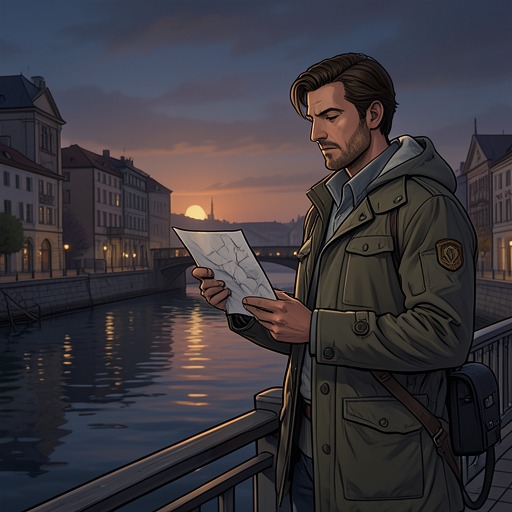
The man sends his farewell letter
Anxious PeopleThe man sends his farewell letter ten years before the apartment hostage crisis, after the financial collapse has turned his savings into debt and a bank employee has refused his request for help. The letter’s importance lies not only in what it eventually says, but in the long silence around it: Zara carries it for years without opening it, while the events surrounding the man’s death continue to shape her life and Nadia’s. When Nadia finally reads its four words aloud, the letter offers a new way to understand responsibility and survival.
Circumstances and purpose
The man’s financial crisis begins with savings placed in investments described as secure. He then uses those investments as security for loans and takes out further loans to repay earlier ones. The bank presents the practice as ordinary, but when the market collapses, his savings disappear and a mountain of debt remains. The financial system survives the crash; his livelihood and security do not.
Seeking another loan, he tells a second bank that without help he could lose his business and home, and that he has two children. A woman there explains moral hazard through the image of two people on a branch, with the bank holding the saw and the customer bearing the danger. She refuses to authorize a loan. The man protests that the loss was not his fault. His letter is addressed to this woman, and the explanation he received gives the act its moral context: the bank’s account of risk has left him carrying the consequences, while his own appeal has failed to change the outcome.
The narrative does not disclose the letter’s full contents when it first introduces it. It establishes instead that the man wrote down what he wanted the bank employee to hear and mailed the letter. That withholding makes the letter both a record of an unanswered grievance and a delayed message whose recipient cannot yet bring herself to read it.
Mailing and the events that follow
After mailing the letter, the man takes his children to school, tells them that he loves them, drives away alone, and goes to the bridge. He climbs onto the railing and jumps. The account places the ordinary act of taking the children to school beside his decision to leave them, making the letter part of a final sequence rather than an isolated gesture.
The man’s death enters Nadia’s life soon afterward. A week later, she stands on the same bridge railing. She attends the same school as the man’s children, and news of his death has circulated there. Jack pulls Nadia down from the railing and stays connected to the moment as the boy who saved her; she is taken to hospital. The narrative does not claim that the letter itself causes Nadia’s crisis. Rather, it shows how the man’s death becomes part of the circumstances in which another young person reaches the same bridge, and how Jack’s intervention changes what follows for both of them.
Zara, the recipient, and the letter’s long afterlife
The bank employee is Zara. She has kept the letter in her handbag for ten years. On the night Nadia was rescued, Zara watched from the darkness without approaching, then found Nadia’s wallet and learned her name. She spends the following years watching Nadia’s education and early career from a distance, and repeatedly views apartments with balconies overlooking the bridge. The letter and the bridge become joined in her private history: both point back to the man’s death and to the girl she saw survive.
Zara eventually becomes Nadia’s patient, but she does not tell her the whole story. She has claimed that apartment viewings are a recent hobby, although she has been attending them for years. The apartments’ balconies give her a distant view of the bridge; she fears returning there directly and fears what she might learn by approaching Nadia. She has not opened the envelope. Her silence leaves the message in suspension, even as she builds her life around the place and people connected to it.
The letter is finally read
Ten years after the man’s death, Zara lets the envelope slip from her hand during a conversation with Nadia. She wants to explain that the letter brought her to Nadia’s office and that she needs someone to read it aloud, but she can only begin to say Nadia’s name. Nadia opens the old handwritten note and reads its four words: It wasn’t your fault. The letter’s contents, withheld through years of fear and secrecy, become a direct answer to the guilt Zara has carried since witnessing Nadia on the bridge.
The message does not undo the man’s death or erase the circumstances that brought Zara and Nadia to the bridge. Its significance is that it interrupts Zara’s conviction that she is responsible and gives the two women a way to face the past together. In the wider story, the letter connects the man’s financial ruin, his final departure, Nadia’s rescue, and Zara’s long silence. What began as a message to a bank employee becomes, when finally read, a small but decisive act of recognition between people who have spent years alone with the consequences of that night.